

In the blink of an eye, a safe journey on the roads turns into an accident just like that. The cars ahead come to a stop suddenly; a pedestrian crosses the road; the traffic comes to a halt before the driver is able to do something about it. It is here that the Automatic Emergency Braking (AEB) system comes in handy.
Driver assistance technology detects the collision risk and alerts the driver and, in some cases, applies the brakes by itself.
AEB is a sophisticated driver-assist feature that is capable of sensing an imminent crash situation and braking automatically. This depends on the type of vehicle, as the other car, a pedestrian, a cyclist, or another object may be sensed.
The process usually takes place together with a forward collision warning feature. The warning is used to inform the driver about the dangerous situation, and AEB assists in the case where the driver fails to respond in time. While some AEBs can partially brake, others can brake strongly depending on the situation.
AEB is not the same as ABS (anti-lock braking system). ABS helps stop the wheels from locking in case of emergency braking.
This process includes sensing, assessment, warning, and finally braking.
A sensor evaluates the area in front of the vehicle. As per the design criteria of the AEB, this technology is supposed to use either cameras or radar technology to identify possible dangers, such as cars, pedestrians, bicycles, and any other obstacles that can be dangerous to the vehicle.
Constant assessment takes place with respect to elements such as the position and movement of objects, the speed of the car, and the distance between them. When it detects that there is a possibility of collision, it will produce a warning of forward collision.
When the driver fails to react accordingly, emergency automatic braking can kick in. It might help reduce the vehicle's speed or bring the vehicle to a complete halt if possible. Different manufacturers have different designs in this regard. Some work at certain speed limits, while others work at high speed limits.
Also Check: Plug-In Hybrid vs Hybrid: Which is Right for You?
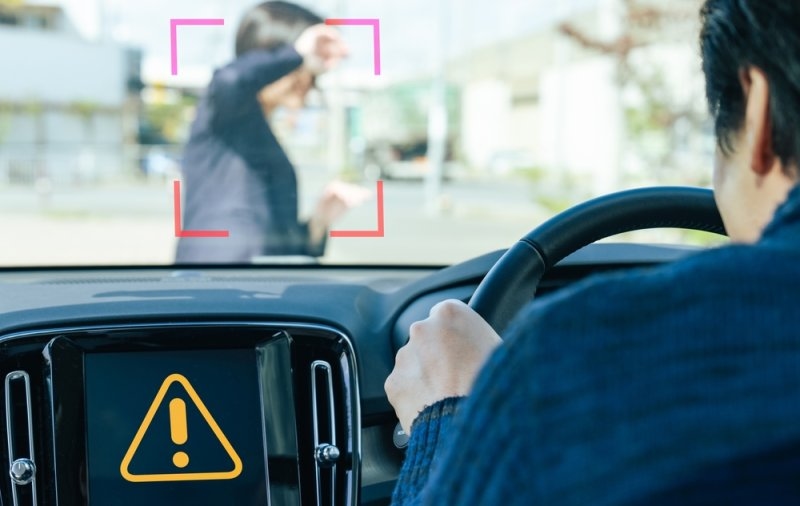
Not all systems can perform the same tasks. Simple AEB may focus only on the detection of the presence of a car ahead of the driver, whereas more advanced technologies can detect pedestrians and even cyclists.
Forward AEB can detect an obstacle and take action in case of a collision. It can become useful in circumstances of a traffic jam and stopped cars ahead.
In addition, there are some more advanced systems with pedestrian and cyclist detection functions. They can also assist in applying the brakes in case one of the vulnerable road users becomes a threat.
But detection cannot always work in the same way. According to Consumer Reports, pedestrian-detection systems may not be able to see pedestrians and cyclists during the nighttime or at turns.
Also, rear AEB technology is present in some cars. This technology allows the brakes to be used automatically in reverse if the system sees a possible rear-end collision.
An AEB safety feature is meant to decrease the effects of an accident in case the driver is unable to react in time.
Based on the information from the Insurance Institute for Highway Safety, as stated in Consumer Reports, cars that have AEB and forward collision warning have much lower rates of rear-end accidents. Consumer Reports mentions that the two technologies combined decrease such accidents almost by half.
The device may be especially helpful during emergency braking or even in the inattentiveness of the driver. However, one should consider AEB as a backup option but not as an excuse for driving close behind or inattentive driving.
AEB can be valuable, but it does not replace safe driving at all times.
The effectiveness of the technology could be different depending on the speed of the car, road design, weather, light conditions, and even the obstacle itself. The cameras and other devices could be affected by dirt, rain, or anything else obstructing them.
Furthermore, it is important for drivers to know that automatic brakes will reduce the intensity of the impact but not completely stop it. The system may not identify all dangers that are present, and there might not be enough time and space to brake.
This explains why drivers need to keep a safe distance from the vehicle ahead.
Most of the newer cars come with AEB, but there may be variations in terms of what features they come equipped with depending on make and model.
It should also be noted that various manufacturers refer to their AEB systems using various trade names, so one needs to know exactly what safety features the car comes with.
While shopping for a car, look at whether AEB comes standard and how much it can see - the car could come with AEB, but only forward and pedestrian detection could be absent. Used car buyers need to be especially careful about the version of the car they are buying.
You may also like: Types of Automatic Transmission: Find the Best Fit for a Car
The implementation of automatic emergency braking (AEB) has grown into one of the vital elements of modern cars' safety features. It detects obstacles on the road and initiates the braking process when a crash seems inevitable, thus helping the driver to prevent accidents and minimize their effects.
It has various abilities depending on the car model, and there is no single AEB system that would be able to notice all threats and replace the driver. Knowing its potential and limitations makes it possible for drivers to use AEB properly.
A large number of the newer cars that are now on the roads come equipped with an auto-braking system as a standard feature. This feature varies from car to car in its capabilities depending on the make, model, year, and trim of the car. Some systems detect only vehicles, while others can detect pedestrians, cyclists, and rear collisions.
In certain circumstances, it is possible for AEB to slow down or even stop a moving car, although this is not guaranteed, as it varies according to circumstances. These include such things as the speed of the vehicle and its stopping distance.
There are certain auto-braking systems that work at highway speeds, while there are others that have less capability than this. It’s important to do proper research about your vehicle.
AEB can operate in various conditions, but its performance may be affected by heavy rain, darkness, glare, dirty sensors, or other conditions that interfere with cameras or sensors. Pedestrian and cyclist detection can be particularly challenging in poor visibility.
The exact behaviour depends on the vehicle. Drivers should consult the owner's manual to understand how the system responds to steering, braking, accelerator input, and other driver actions. Regardless of the system's intervention, the driver remains responsible for controlling the vehicle.
This content was created by AI